MARKETING REPORTING FRAMEWORK FOR PERFORMANCE TRACKING AND INSIGHT
Give Performance a History
Create a consistent record of marketing performance that preserves what happened, keeps meaningful evidence in context, and builds understanding over time.
Marketing creates evidence everywhere it operates. Advertising platforms record delivery and response. Websites capture behavior. CRMs follow leads and customers. Email, social media, call tracking, vendors, sales systems, and offline activity add their own pieces to the performance picture.
Having access to that information is different from maintaining a reporting practice. Marketing data comes from different systems, develops at different speeds, and reflects different parts of the customer journey. Without a consistent way to take stock of performance, teams can spend plenty of time looking at results without building a dependable record of what happened.
Reporting creates recurring opportunities to capture that evidence while the activity surrounding it is still understood. It keeps important measurements visible, preserves enough context to recognize when performance moves, and gives those observations somewhere to accumulate. The work can be as simple as a regular dashboard review or as structured as a formal reporting process, depending on what the organization needs.
The Method organizes Reporting through Monthly Reporting, Weekly Reporting, KPI Tracking, and Reporting Cadence & Timing. Together, they help determine what deserves to be recorded, where greater detail is useful, which signals should remain prominent, and when the evidence is ready to review. As those checkpoints accumulate, individual observations become a performance history that can support deeper evaluation.
Evidence Needs Somewhere to Go
Carry the structure behind active marketing into a reporting record that keeps performance connected to the work that produced it.
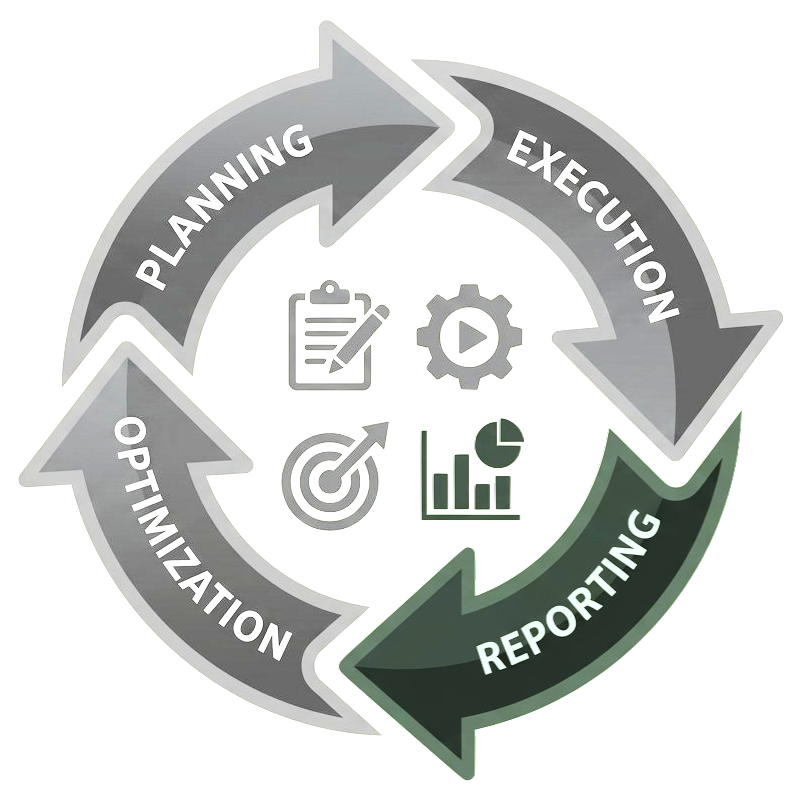
Planning establishes direction before marketing enters the market. Execution turns that direction into organized activity while preserving enough structure to understand what was actually done. Campaign roles, channel organization, tracking, and testing all give the resulting performance context before Reporting ever begins.
That context helps Reporting move beyond a collection of platform results. Awareness activity can be reviewed against the job it was intended to perform. Traffic can be understood as a different responsibility from Conversion. A test can remain connected to the question it was designed to explore. Channels can retain the measurements that make them useful without becoming isolated from the larger strategy.
Reporting then records what becomes visible. It can preserve an increase in exposure, a change in engagement, movement in website traffic, developing conversion volume, or a period that behaved differently from those around it. Known activity can remain alongside those results so the organization has more than the number itself when it returns to the period later.
The evidence does not need to explain its own cause. Reporting preserves what happened and enough of the surrounding context to make later evaluation possible. That boundary keeps the performance record useful without asking every recurring checkpoint to become a strategic review.
Build the Record Over Time
Use recurring observations to turn individual reporting periods into a more useful view of how marketing behaves.
A single reporting period provides a snapshot. Repeated periods begin establishing the pulse of the marketing program, making it easier to recognize when performance changes, whether movement continues, and where a larger review may eventually need to look closer.
The Method creates that history at the level the work requires. Monthly Reporting provides a dependable checkpoint across active marketing, while Weekly Reporting adds greater resolution where shorter periods preserve meaningful variation. KPI Tracking narrows the available measurement environment to signals worth following, and Reporting Cadence & Timing helps keep those observations consistent enough to compare as the evidence develops.
Not every organization needs the same reporting artifacts to maintain that rhythm. A business owner may rely primarily on dashboards and a focused monthly review. A marketing team may maintain recurring internal reports. An agency may need formal client deliverables completed within defined reporting windows. Each can build a useful performance history when the underlying practice keeps important evidence visible and preserves enough context to return to it later.
As the record grows, small movements gain perspective. Several monthly checkpoints can show how performance developed across a quarter. Weekly observations can explain variation hidden inside a monthly total. KPI history can make movement across different parts of the customer journey easier to see. Dashboards and source platforms remain available for deeper investigation, while the reporting record preserves the pulse that developed along the way.
That accumulated history creates the handoff to Optimization. Instead of beginning a larger review by reconstructing what happened from memory or relying only on what current systems show, the organization begins with evidence that has been observed and organized while the marketing was running. Optimization can then evaluate that history, investigate what warrants a closer look, and determine what the evidence supports doing next.