Marketing decisions rarely exist on their own. An audience can influence the message. The message can influence the channel. The channel can influence the budget, creative, timing, and how results are measured. Change one variable and it may affect several others.
Experience, research, data, customer feedback, and even instinct can all help guide those decisions. The challenge is creating a consistent way to organize that thinking so the reasoning behind a decision remains connected to what happened when it was put into action and what was learned along the way.
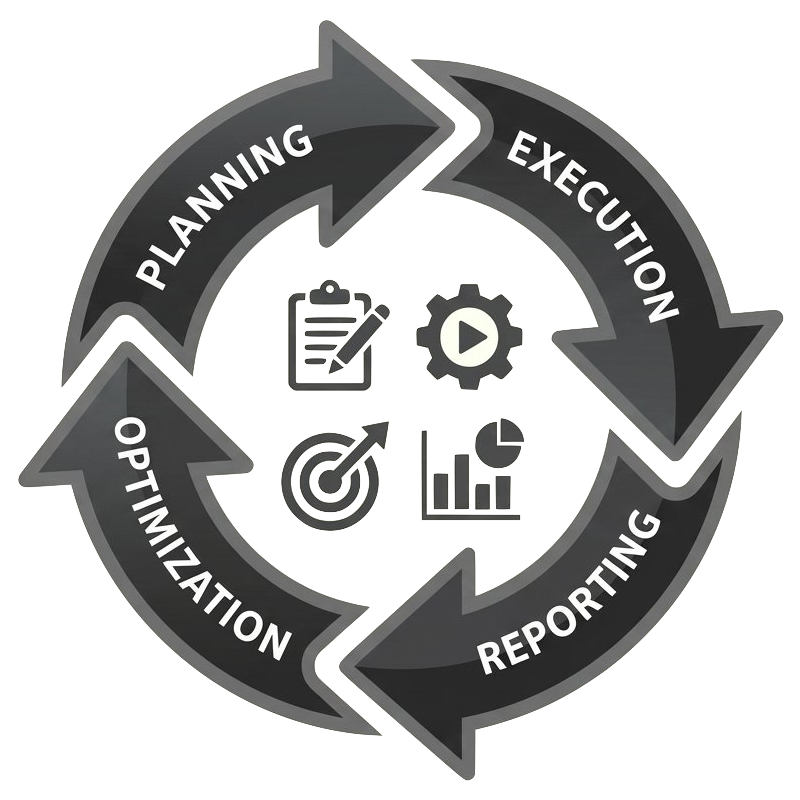
The Method provides that structure by connecting Planning, Execution, Reporting, and Optimization (PERO) into one continuous process. It creates a common way to organize marketing without prescribing what the answer should be.
Different businesses will reach different answers. Their audiences, objectives, resources, industries, channels, and circumstances are different. The Method helps organize those variables so each decision can inform the next, creating a marketing process that becomes more informed over time.
Marketing Performs Better When the Pieces Work Together
Marketing is often divided by specialty, channel, campaign, or responsibility. Strategy may happen in one meeting, execution somewhere else, reporting in a dashboard, and optimization when someone decides something needs to change. Each can be done well on its own while still leaving gaps between them.
PERO organizes marketing differently. Planning establishes the reasoning behind what should be done. Execution turns those decisions into activity while preserving the structure needed to understand it later. Reporting connects what happened back to the decisions, conditions, and activity that preceded it. Optimization uses that understanding to determine what the evidence actually justifies doing next.
The connection between those responsibilities is what makes the process useful. Reporting is stronger when Execution was organized with measurement in mind. Optimization is stronger when Reporting provides context instead of isolated metrics. And the next round of Planning becomes stronger when it begins with what the organization has already learned.
Marketing still requires judgment, expertise, creativity, and experimentation. PERO gives those things a structure in which each decision can contribute to the next.
Planning
Good marketing decisions begin with context. Planning brings the business need, audience, competition, messaging, resources, and objectives into focus before deciding where marketing should go.
Explore Planning
Execution
A plan only becomes useful when it can be put into practice. Channels, campaigns, creative, tracking, responsibilities, and standards all need to work together without losing the strategy that informed them.
Explore Execution
Reporting
Clicks, leads, sales, calls, impressions, and other metrics tell pieces of the story. Reporting adds the activity, investment, timing, customer behavior, and business conditions needed to understand what those results actually mean.
Explore Reporting
Optimization
Sometimes the right decision is to change something. Sometimes it is to give it more time. What has been learned helps determine whether to continue, refine, expand, reduce, or stop and gives the next round of Planning better information to work with.
Explore Optimization
Built to Adapt. Designed to Improve.
An operating process shaped by years of real-world marketing and the different ways organizations put it into practice.
The thinking behind The Method began taking shape in the early 2000s and was sharpened through years of work on both the agency and client side. Different industries brought different challenges. Budgets changed, new channels emerged, teams grew or contracted, and the work continued to evolve. What began as a practical way to organize marketing decisions gradually became a more systematic approach, often used alongside consulting to bring greater structure to the work.
Today, that approach has been formalized as The Method, a structured marketing operating process that serves as the chassis behind the work. It can sit behind a business owner making decisions directly, a marketing team coordinating multiple efforts, or an agency working across clients. In each case, it creates a shared cadence for moving from Planning through Execution, Reporting, and Optimization before beginning the cycle again.
That structure is intentionally malleable. A large marketing department moving quickly across multiple channels does not need the same workflow as a small business making a handful of marketing decisions each month. Experience changes how the process is used as well. The Method can become more detailed when the work requires it and remain straightforward when it does not.
The goal is not to make every marketing cycle look the same. It is to make the next one more informed than the last. Reporting puts performance into context, giving Optimization something meaningful to evaluate. What is learned then becomes part of the next Planning cycle before another round of work reaches the market.
Over time, a rhythm develops: make the decision, do the work, understand the result, improve what happens next.
Improve What Happens Next
Marketing Takes Different Shapes
Marketing can be managed by a business owner, divided across an internal team, supported by outside specialists, led by an agency, or shared among all of them. The people, titles, resources, and level of expertise may change, but the fundamental work does not. Direction still needs to be established, ideas need to be put into action, performance needs to be understood, and someone needs to decide what happens next.
Business Owner
See the Bigger Picture
Understand where marketing resources are going, why decisions are being made, and how performance informs what happens next.
For Business Owners
Marketing Team
Keep the Work Connected
Bring strategy, campaigns, channels, specialists, and results into a shared process without limiting the expertise behind the work.
For Marketing Teams
Agency
Create a Common Structure
Apply a repeatable process across different clients, services, and teams while adapting to the marketing needs surrounding each engagement.
For Agencies
How The Method Works
The Method is designed to provide structure without requiring every organization to use it in exactly the same way. Getting started begins with understanding how marketing operates today, including who is involved, how decisions are made, what is already being planned and measured, and where greater structure may be useful. From there, the process, tools, and level of support can be adapted to the experience, resources, and needs of the people using it.