A marketing plan can establish where a business wants to go without resolving every decision required to get there. Once the work begins, strategy enters environments with their own requirements. Paid media platforms organize activity differently from email systems. Search behaves differently from social. Traditional channels may offer fewer direct signals than digital ones. Internal teams, agencies, vendors, and technology can each influence how the work is ultimately built and managed.
Those differences are part of execution, but so are the connections between them. A campaign created to support awareness should remain understandable as an awareness effort after it enters a platform. A message developed for a particular audience should remain recognizable as creative is produced and distributed. Tracking should preserve useful information as people interact with the marketing, while intentional experiments should create opportunities to learn rather than adding change for its own sake.
The Method uses Execution to organize those connections without prescribing a universal campaign structure or replacing the expertise required to operate individual channels. The business still determines its strategy, specialists still apply their expertise, and existing systems can remain in place when they serve their purpose. Execution provides the standards that help those decisions remain connected as marketing moves from intention into activity.
Execution Connects Planning to What Actually Enters the Market
Within PERO, Execution receives direction from Planning and turns it into an operating environment that can eventually produce evidence for Reporting and learning for Optimization.
Planning reduces uncertainty before the work begins. Competitive Analysis develops a clearer understanding of the market, the Messaging Framework establishes how the organization intends to communicate, and the Flight Plan connects priorities, channels, timing, resources, and other decisions across the marketing program. Together, they create a reasoned direction for what should happen next.
Execution takes over when those decisions begin encountering reality.
A planned channel may require more preparation than expected. An existing account may already contain years of campaigns that should be understood before anything is rebuilt. Budget can limit how many audiences or creative variations receive meaningful support. Technical systems may determine which interactions can be captured, while the requirements of an individual platform can influence how a campaign is structured once it enters market.
These realities do not automatically invalidate the plan. They are information the organization needs as it determines how the plan should be executed. The role of Execution is to accommodate those conditions without allowing the original purpose of the work to disappear inside them.
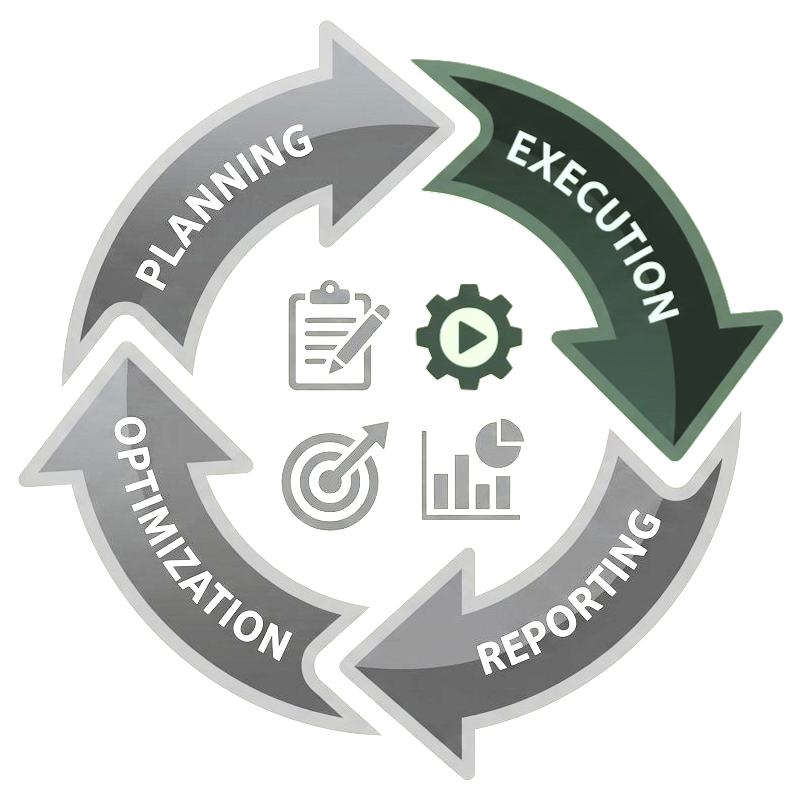
That position within PERO also explains why organization during Execution matters beyond the launch itself. Reporting will eventually need to understand what happened, but performance data becomes more useful when the activity behind it can still be identified. Optimization will eventually evaluate what deserves to change, but those decisions become more informed when the organization knows how the marketing was structured, what conditions surrounded it, and which changes were introduced intentionally.
Execution therefore creates more than activity. It creates continuity between what the organization intended to do and what later phases will have an opportunity to observe and learn from.
Organized Marketing Creates Context Around the Work
A marketing program can be active across many channels and still make it difficult to understand how the pieces relate to one another, particularly as the number of campaigns, audiences, creative assets, vendors, and systems grows.
The symptoms are often ordinary. Search campaigns are generating leads while social campaigns are building awareness. Email supports existing relationships, events create direct engagement, and traditional media increases visibility in the market. Different agencies or internal teams may manage each part effectively within their own environment, yet the business can still struggle to see how those activities work together.
That becomes more noticeable when larger questions emerge. The organization may know how much it spends on each channel without knowing how that investment is distributed across the customer journey. A campaign may be labeled as a conversion campaign even though its audience, creative, and destination function primarily as an introduction to the brand. Tracking may confirm that a form was submitted without preserving enough context to understand which marketing preceded it. Several pieces of creative may be running simultaneously without anyone knowing whether they represent an intentional experiment or simply accumulated over time.
Execution gives those questions somewhere to be addressed before the organization reaches Reporting and attempts to reconstruct the answers from performance data alone. It creates an outside view of how marketing activity contributes to the customer journey, then carries that organization into the environments where the work is built. From there, useful information can be preserved as customers interact with the marketing, and meaningful changes can be introduced with enough structure to learn from what happens.
The appropriate level of structure depends on the organization. A local business operating a handful of channels does not need the same campaign architecture, tracking depth, or testing environment as a national advertiser managing multiple agencies and markets. What matters is whether the structure is sufficient for the people responsible for the marketing to understand what is happening and preserve that understanding as the program evolves.
From Activity to Evidence
The four components of Execution progressively make marketing easier to understand, operate, observe, and learn from without requiring every channel or organization to work the same way.
The process begins by giving marketing activity a role. Campaign Architecture looks across the program and connects channels, campaigns, and investment to the parts of the customer journey they are intended to support. This creates a common view of the marketing environment before individual platforms and channel structures begin separating the work into their own terminology.
That purpose then needs to survive inside the channels themselves. Channel Setup Standards examines whether campaigns, audiences, creative, naming, destinations, and other meaningful elements are organized in a way that reflects what the activity is actually trying to accomplish. The exact structure can differ by channel and organization, but the work should remain identifiable enough to connect back to the larger marketing system.
Once activity is organized, Attribution & Tracking Setup considers what information can reasonably survive the customer journey. Platform identifiers, URLs, calls, forms, landing pages, CRM fields, search information, QR codes, and other mechanisms can create connections between interactions that would otherwise disappear. Not every connection will be available, and not every channel will provide the same level of certainty. The objective is to preserve useful evidence where the marketing environment allows it while remaining clear about what the available information can and cannot demonstrate.
Testing & Experiment Structure adds another layer by considering whether intentional changes are being introduced in a way that can produce useful learning. When the organization has a question worth spending resources to answer, the surrounding variables, budget, audience, exposure, timing, and available signals can be arranged to give that question a fair opportunity. The result is not experimentation for its own sake, but a marketing environment capable of learning from the changes already occurring within it.
Together, these components move Execution beyond the act of launching campaigns. They create enough continuity around marketing activity that the organization can understand what it put into market, preserve evidence of what happened, and carry useful context into the decisions that follow.
Structure Should Support the People Doing the Work
Execution standards are most useful when they improve the marketing environment without forcing teams to replace systems that already provide the structure they need.
An experienced agency may already have a thoughtful naming convention. An internal team may have established account structures, project-management workflows, or technical tracking standards that have developed over years of work. A specialist may organize a particular channel differently because its platform, audience, or measurement requirements call for a different approach. The Method does not need those systems to look identical in order for them to work together.
Instead, Execution provides a way to evaluate whether the necessary information is surviving across them. Marketing activity should have an understandable role. Its setup should support that role rather than obscure it. Useful customer and campaign information should be preserved where reasonably possible, and intentional tests should be structured around questions the organization actually wants to answer.
Those standards can reveal gaps, but they can also confirm that an existing system is already doing its job. The value comes from understanding why the structure exists and whether it gives the organization enough context to continue through the operating process.
As that context accumulates, Reporting no longer has to begin by asking what everyone remembers doing. It can begin with an organized view of the activity that actually entered the market and the evidence that activity produced. Optimization can then evaluate that evidence against the decisions and conditions that created it, allowing the next round of marketing to begin with more knowledge than the one before it.
Execution is the point where marketing becomes real. The structure built around it helps ensure that reality remains understandable.